
Disaster Risk Management & Climate Change Adaptations Advisories
Reduce Vulnerability. Adapt to Future Climates. Enhance Preparedness
OVERVIEW
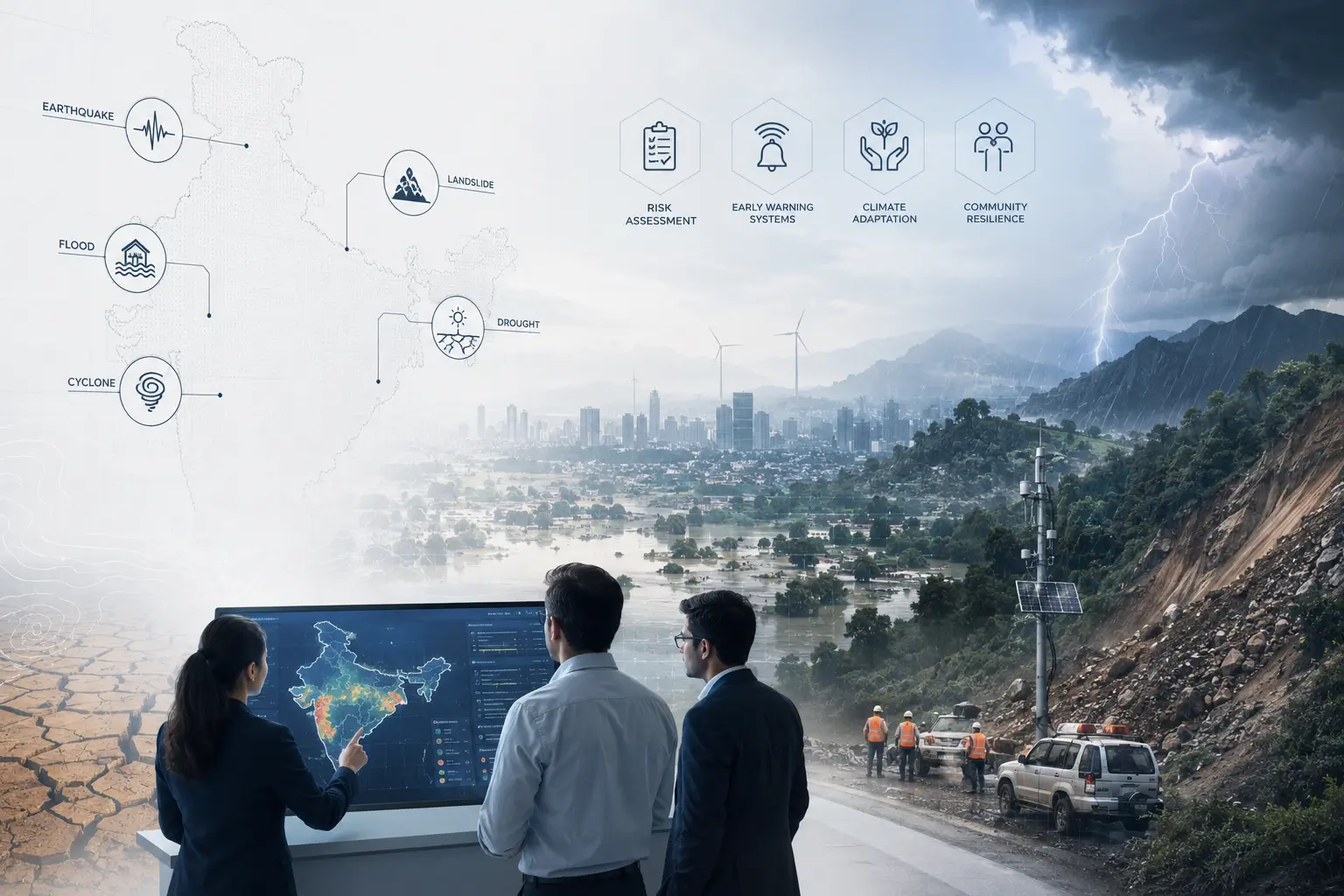
India, with its large population and territory, and diverse geophysical and climatic conditions, is one of the most disaster-prone regions of the world. 85 percent of India’s area is vulnerable to one or more type of hazards, with 57 percent being vulnerable to earthquakes. The UN Office for Disaster Risk Reduction has ranked India at No. 3 (after China and the USA) in recording the highest number of natural disasters.
Reports of the UN’s Intergovernmental Panel on Climate Change (IPCC) present a troubling forecast for South Asia, viz, that with global warming set to hit 1.5 °C in the 2030s irrespective of the low, medium or high-emission scenarios, the region will see hotter weather, longer monsoon seasons, and increased droughts. It highlights that India will be one of the most severely hit countries from climate change which will manifest in four main ways:-
- An increase in the numbers, scale and intensity of climate change-associated hazard events particularly erratic rainfall; severe floods; cloudbursts; cyclones; landslides;
- Rise in ambient temperatures;
- Sea rise and coastal erosion.
- Aggravation of health problems.
Overall, the situation will be exacerbated by an increase in population and a trend towards urbanization. And together, will impose a severe economic, human and social cost, and impinge on developmental agendas.
On account of these reasons, India’s 16th Finance Commission (FY2027-2031) has allocated Rs. 1.6 lakh crore for Disaster Management grants to states / UTs, a 27% increase over the previous cycle.
With allocations for response, relief and mitigation being enhanced, the 16th Finance Commission as well as the States / UTs are looking at improving efficiencies for better utilization as well as investing in Disaster Risk Management institutional development.
WHAT WE DO
Capabilities
Strategic Advisory
Developing short, mid and long-term strategies for industry, businesses, schools, administrative bodies / local governments of towns / cities / districts / States to mitigate the effects of hazards, industrial accidents and climate change and in other fields of disaster management / disaster risk reduction, and which align with growth targets and national objectives.
Policy & Programme Advisory
Lead the development of guidelines, training curriculum, evaluation tools, on-site and off-site plans, and emergency / disaster response methodologies which conform to the mandated governmental guidelines and stipulated Sustainable Development Goals (SDGs).
Strategic Risk & Resilience
Analyse implications of Climate Change, Extreme Weather, requirements of Lifeline Networks and Critical Infrastructure for business, industry and towns / cities. Strengthen preparedness through enterprise risk management, resilience planning, scenario planning, and crisis preparedness.
Strategic Risk & Resilience
Strengthening preparedness through enterprise risk management, resilience planning, scenario planning, and crisis preparedness.